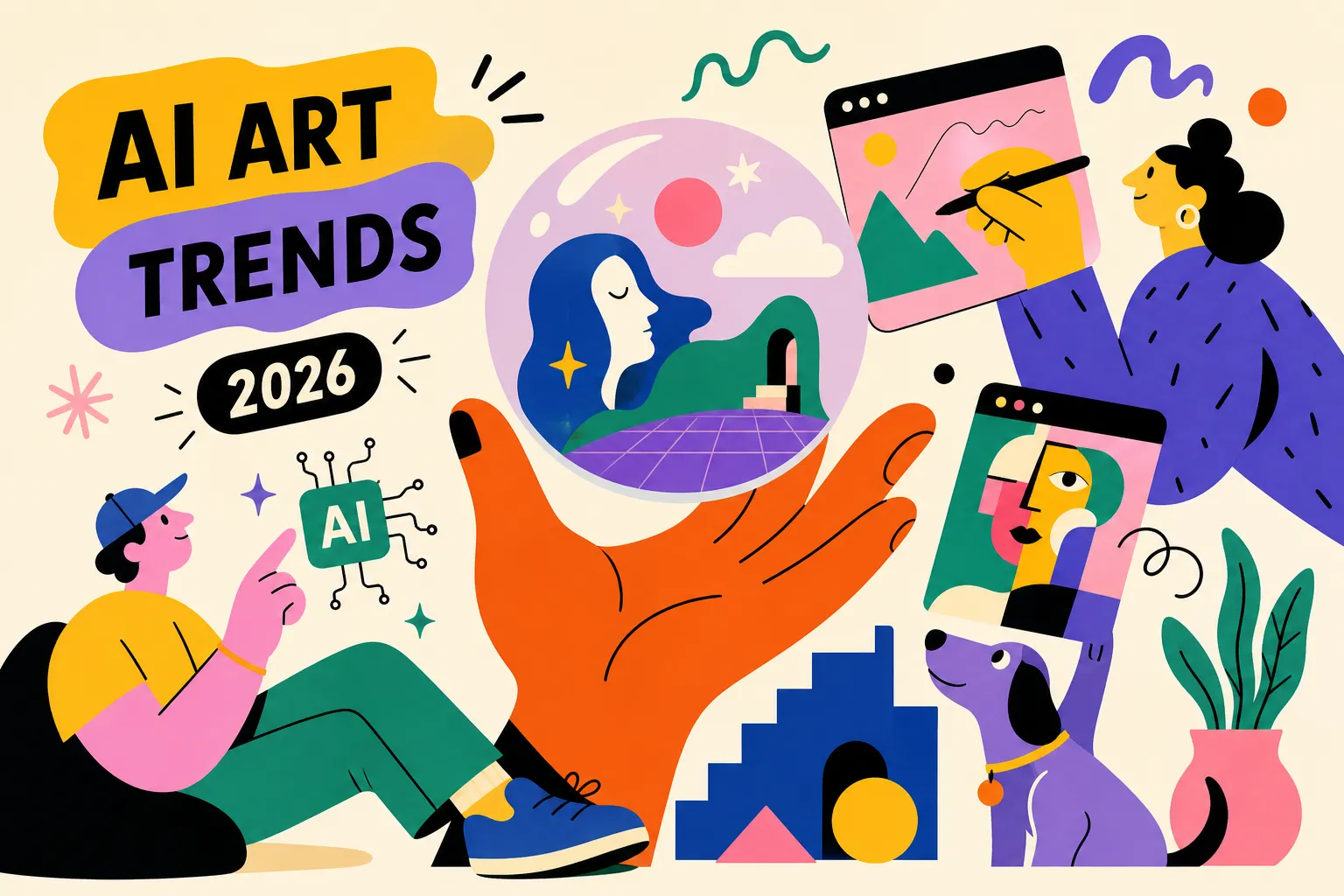
The AI-generated imagery dominating social feeds in 2026 has evolved dramatically since 2024, leaving behind the flat, slightly-off pictures people once associated with generative tools. These styles are cinematic, tactile, and emotionally resonant. Earlier text-to-image outputs often showed fewer visible traces of human making; today’s work carries a sense of human presence that makes it genuinely compelling. If you’ve been watching the feeds and wondering what shifted, the current AI art trends point in three clear directions: hyperrealism, retro-futurism, and mixed media have emerged as the defining visual movements of this moment, at least from where professional creators and platform data are sitting right now.
Recognizing a trend is only half the job. The other half is knowing how to create it, which tools to use, what legal ground you’re standing on, and where the actual money is. This guide covers all of it, from the visual characteristics and prompts to the copyright basics and monetization strategies that professional creators are using right now.
1. AI Art Trends in Hyperrealism: The Style That’s Making People Look Twice
What’s driving the hyperrealism wave right now
Hyperrealism in generative art goes well beyond photographic accuracy. The defining qualities are ultra-detailed skin textures, controlled cinematic lighting, and compositions that feel pulled from a high-end editorial shoot or a premium film still. These images are widely reshared on Instagram and TikTok, one likely factor is their increased realism, which makes them harder to immediately identify as AI-generated and creates the kind of pause that drives engagement.
The deeper reason this style resonates emotionally is that it gives AI-generated work something earlier outputs often lacked: a perceived sense of human presence. Pores, subtle imperfections, realistic hair strands, soft background blur, and lens-like depth of field all signal “this was made by a person with a camera.” That emotional cue is powerful, and it’s a core reason hyperrealism ranks among the most-shared generative aesthetics on social platforms right now. It’s one of the text-to-image trends that has genuinely changed how audiences interact with AI-created work.
How to recreate it with accessible tools
Two platforms are prominent in this aesthetic. FLUX models are a go-to for high-fidelity realistic outputs, particularly portraits and product-style imagery, and have appeared consistently in 2025, 2026 roundups of photorealistic generation tools. Midjourney’s latest version leans more cinematic and editorial, making it ideal when you want the feel of a polished film still. Both tools respond well to specific, detailed prompts rather than vague descriptors, and both reflect broader Midjourney and Stable Diffusion trends toward higher-fidelity outputs. For a concise overview of AI image models and how they compare, see model-focused resources that map capabilities to aesthetic outcomes.
Three prompt strategies tend to produce consistent hyperrealistic results. First, specify the lighting conditions: “golden hour rim light,” “single diffused studio light from the left,” or “overcast diffused natural light” all guide the model toward believable illumination. Second, add camera-style language: “85mm lens, f/1.8 aperture, shallow depth of field” triggers cinematic depth that makes the image feel photographed rather than generated. Third, include texture descriptors: “realistic skin pores,” “subtle freckles,” “flyaway hair” push the model toward the micro-detail that makes hyperrealist work so convincing. These approaches align with documented prompt-sensitivity research showing that specificity in lighting and texture descriptors consistently improves photorealism in 2025, 2026 outputs. If you want a focused primer on crafting effective inputs, see How to Write Great AI Prompts: A Simple Guide for Beginners, Techiein.com, Latest Tech News for structure and example prompts.
2. Retro-Futurism Gets an AI Makeover in 2026
The visual language creators are running with
Retro-futurism in 2026’s generative art scene blends 1970s and 1980s sci-fi aesthetics with the polish that modern AI models can now deliver. Think chrome surfaces, cathode ray tube glow, cassette-era color palettes built around mustard, burnt orange, and slate blue, and spacecraft interiors that feel like Stanley Kubrick designed them on a vintage synthesizer soundtrack. The visual language is rich, specific, and immediately recognizable, and it’s one of the synthetic art styles that translates especially well to AI generation.
This trend is fueled by two converging forces. First, there’s nostalgia fatigue with hyper-digital, ultra-clean aesthetics: audiences want warmth, grain, and imperfection. Second, the retro-futurism style converts well into shareable social content. Airbrushed gradients, bold heroic compositions, and era-specific typography all create images that stop the scroll because they look like artifacts from a timeline that never quite happened.
Prompts and platform picks for this aesthetic
Midjourney handles this style with strong consistency, and ChatGPT’s image generation has made it accessible to creators who don’t want to manage complex workflows. The core prompt ingredients that reliably produce retro-futurist results follow a clear formula: era reference + specific sci-fi artifact + material callouts + mood language. An example: “1970s science fiction paperback cover, lone astronaut on a red desert moon, airbrushed illustration, ochre and teal palette, halftone print texture, faded ink, dramatic heroic composition.” That combination gives the model an unambiguous visual target.
For adding era-accurate typography, Ideogram is worth testing separately. It handles text-in-image better than most models, which makes it useful when you want the composition to include a title treatment, tagline, or poster-style headline that looks like it belongs to the 1970s. If you’re layering platforms in your workflow, Ideogram for type plus Midjourney for illustration is a productive combination for retro-futurist poster work.
3. Mixed Media and Phygital Art: When Digital Meets Handmade
Why the blended aesthetic is having a cultural moment
Audiences in 2026 are drawn to AI work that carries visible traces of human making, a pattern that aligns with broader AI art predictions for this year emphasizing materiality and human, AI co-creation. Gemini Ai Photo Prompt Trending Mixed Media, Techiein.com, Latest Tech News showcases practical examples of how mixed approaches layer generated content with analog textures to create a tactile finish. Mixed media AI art layers generated imagery with scanned textures, hand-drawn marks, photography, and physical materials like paint, collage, and paper. The result occupies a new middle ground: it doesn’t look like pure AI output, and it doesn’t look like traditional art. It looks personal, and that distinction matters enormously to how audiences receive and share it.
The “phygital” approach, combining physical and digital integration, takes this further. Artists are printing AI-generated imagery onto canvas or paper, adding physical paint marks or stitched elements, scanning the result, and then refining digitally. The workflow sounds involved, but it produces work with a tactile quality that prompt engineering alone can’t replicate. A practical 2026 workflow runs like this: generate a compositional base in AI, print it, add painted or collage layers, scan the result, then bring it back into editing software for final refinement.
Human-AI co-creation as the defining creative standard
The most commercially and critically respected AI work coming out of galleries and creator platforms in 2026 treats AI as one tool in a larger process, not the whole process. Artists who publish their workflows, show the physical components, and document their creative decisions tend to pull more engagement and commission work than those who simply post finished AI images with no context. That gap appears to be widening.
This is both a creative and a strategic observation. When you show your process, whether that’s a scanned texture you painted, a compositional sketch you drew first, or the sequence of decisions you made along the way, you establish authorship in a way that a finished image alone cannot. That authorship matters aesthetically, legally, and for building an audience that trusts your work. For wider context on where curators and critics see these directions heading, consider reading curated perspectives where experts predict art trends for 2026.
4. The Tools Turning These AI Art Trends Into Something Anyone Can Make
Matching the right platform to the right style
The tool landscape in 2026 is genuinely broad, but matching the platform to the aesthetic keeps things manageable. Midjourney excels at polished cinematic and retro aesthetics. FLUX is a strong choice for photorealistic outputs. ChatGPT’s image generation works well for fast, accessible experimentation without managing complex settings. Ideogram shines in design-heavy compositions that need accurate text elements. Adobe Firefly is widely regarded as a commercial-friendly option because its outputs are built on licensed content, which gives you cleaner copyright footing when the image is for a client or product, a characterization supported by Adobe’s licensing documentation and consistent industry coverage through 2025, 2026.
None of these platforms is universally “best.” They each have a natural home in the creative workflow, and using the right one for the right style is what separates polished output from generic-looking AI imagery.
Going from trend awareness to actually creating: Techiein’s style guides
Knowing which tools exist is useful. Knowing exactly how to prompt each one for a specific aesthetic, with the right settings, the right structure, and example outputs to compare against, is a different skill entirely. The AI art style guides at Summer Girls Watercolor Gemini Ai Photo Prompt, Techiein.com, Latest Tech News walk through the full creation process for styles like these, including prompt breakdowns, settings recommendations, and before-and-after examples. If you want to stop watching trends and start building your own work, those guides are the practical next step.
5. AI Art and Copyright: What Every Creator Should Understand Right Now
The current U.S. legal position on AI-generated images
The U.S. Copyright Office’s position, reinforced through 2025 guidance and consistent lower-court rulings that the Supreme Court left intact in 2026, is that purely AI-generated images are not copyrightable under current law. Writing a prompt alone does not satisfy the human authorship requirement because the model, not the person prompting it, determines the final output. That’s the current legal baseline. For a legal analysis of the Office’s human-authorship framing, see commentary on the U.S. Copyright Office analysis on the human authorship requirement.
What this means in practice is more nuanced. The more human creative decision-making you can document, through selection, arrangement, physical layering, editing, and compositional choices, the stronger your claim to the work. A person who generates an image and posts it unchanged has a weaker position than an artist who generates, edits, physically modifies, scans, and refines a piece across multiple documented iterations. The gap between “I wrote a prompt” and “I built this through a documented creative process” is where copyright protection starts to attach. Recent litigation and commentary, including coverage of Andersen v. Stability AI, illustrate how courts are grappling with these questions and the risks that remain for creators and platforms.
Practical steps to protect your creative output
Three actions make a real difference here. First, document your creative process and save version history: screenshots, sketches, physical material scans, and edit logs all demonstrate human authorship at each stage. Second, use platforms that offer commercial-safe outputs when the work is for clients or products. Adobe Firefly’s licensed model is the clearest example, but other platforms with explicit commercial licensing also apply. Third, disclose AI involvement transparently. Many platforms and some emerging policies now encourage or require disclosure, Instagram and other major platforms have introduced AI content labeling features, and audiences tend to respond better to honest creators. Transparency functions as both an ethical standard and a practical audience-building strategy.
6. How Creators Are Turning These AI Art Trends Into Real Income
Where the money actually is in AI art right now
Selling individual AI images as standalone pieces has become a tougher play, largely because supply has grown rapidly and stock platforms are crowded with generic generative imagery, a pattern noted by industry commentators tracking price compression in AI-generated stock. The surrounding ecosystem, though, is growing. Professional creators are building income through custom commission work using a distinctive AI-assisted style, digital asset packs and style presets, tutorial content and prompt libraries, and brand content contracts where speed and style consistency matter more to the client than the specific medium. For practical advice on distribution and productization, resources that explain how to sell AI art and what platforms and fulfillment options work well can be helpful starting points.
The common thread in all these models is differentiation. Style, workflow, and process storytelling are what separate creators earning real money from those drowning in undifferentiated output. A distinctive aesthetic that comes with a visible, documentable creative identity is worth far more than technically proficient but anonymous AI imagery. Prompt packs, in particular, have emerged as an income stream for creators with well-developed workflows, though it’s worth noting this is an inferred opportunity based on broader digital-product models rather than a market with widely published revenue benchmarks.
Three concrete steps to adapt your creative strategy
The action framework is straightforward. First, pick one trending style and study it deeply before trying to produce in multiple directions at once. Attempting hyperrealism, retro-futurism, and mixed media simultaneously produces shallow results across all three; going deep on one produces a recognizable body of work. Second, build and document a repeatable workflow so your creative output has a consistent identity that clients and audiences can recognize and return to. Third, package what you know into a product or content format, whether that’s a tutorial, a prompt pack, a commissioned style service, or a digital asset collection. The skill of building a workflow is itself valuable to other creators, and that’s a monetization opportunity that compounds over time.
The Path Forward for AI-Assisted Creators
The AI art trends gaining real traction in 2026 aren’t just aesthetically interesting, they’re roadmaps for what audiences want and what today’s tools can actually deliver. Hyperrealism, retro-futurism, and mixed media each represent a distinct creative opportunity, and any of them is genuinely accessible with the right prompts, the right platform, and a clear understanding of the legal and commercial landscape around them. These AI art predictions for 2026 point toward one consistent theme: human involvement, creative identity, and documented process are what give generative work its value.
Readers who want to go hands-on immediately can find step-by-step AI art style guides at Techiein.com, with prompt breakdowns and example outputs for styles like these. The guides are built for creators who want to build, not just browse. The creators who engage seriously with these AI art trends now, building a repeatable workflow and getting their work in front of an audience, are the ones who will have an established creative identity when the next wave of generative aesthetics arrives. That window is open right now.

TechieIn was founded by MD BELAL, a tech enthusiast driven by a passion for digital innovation and storytelling. With a vision to create a reliable hub for tech lovers, Belal ensures that every piece of content shared here is valuable, timely, and easy to understand.
Thank you for being part of our community. Stay connected, stay updated!